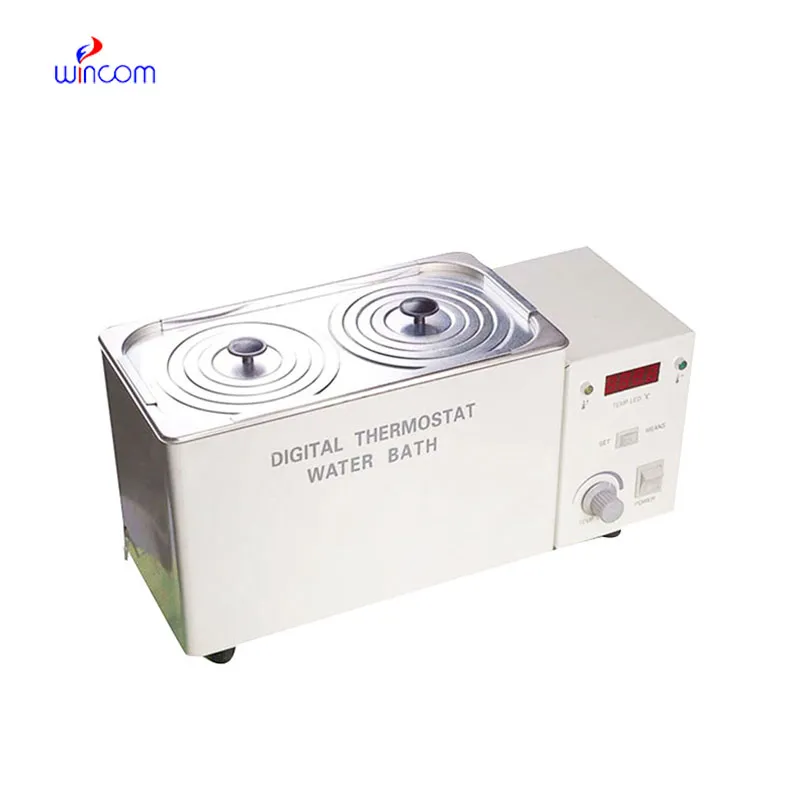
The thermostat circulating water bath delivers precise temperature control and proper heating performance for laboratory use. Its construction is supported by high-quality materials that guarantee both durability and hygiene. The temperature of the water is constant through automated control and constant monitoring. The thermostat circulating water bath also has a basic, plot digital display for accurate readings and quick adjustments. Overheating is prevented through safety features while sensitive samples are protected. Easy to operate and maintain, the thermostat circulating water bath offers quality heating performance for reagent preparation, sample incubation, and analytical research purposes.

Employed extensively in life sciences, environmental testing, and industrial R&D work, the thermostat circulating water bath promotes even heat for sensitive operations. Employed to enable laboratory operations that include heating reagents, culture incubation, and biochemical reaction maintenance, the thermostat circulating water bath is applied in environmental studies for sample conditioning and temperature-related analysis. With a stable thermal response, it minimizes experiment-to-experiment variability. From applications in work done for instruction to research-level work, the thermostat circulating water bath provides a dependable heat environment that enhances the integrity of lab investigations.
Future thermostat circulating water bath will be altered by smart control systems and greater connectivity. The new designs will include self-regulating thermal technology that will be able to change heat automatically based on sample requirements. The addition of wireless communication will allow scientists to observe temperature performance in real-time. The thermostat circulating water bath will also be greener, with the use of materials that minimize energy wastage and environmental impact. The innovation will improve laboratory productivity and facilitate more complex scientific experimentation.

Maintenance of the thermostat circulating water bath on regular basis is a requirement for good performance in temperature and longevity. Scaling and corrosion in the chamber are avoided by regular cleaning. It's best to replace the water after every other day, especially for continuous use. At the intervals, the heating elements and thermostat should be inspected for breakdown or wear. Use gentle cloths and mild soaps to avoid scratching the surface. In normal servicing, the thermostat circulating water bath remains functional and continues to meet laboratory standards year by year.
Designed for precise temperature regulation, the thermostat circulating water bath ensures steady heating during scientific processes. It is largely used in laboratories for incubation of samples, thawing reagents, or heating solutions in precise conditions. The thermostat circulating water bath features a heavy-duty construction and rust-resistant interiors to ensure durability and sterility. Its digital interface allows users to set and hold precise temperatures with precise accuracy. Quiet operation and uniform temperature stability make the thermostat circulating water bath a trustable device for repeated laboratory use.
Q: What makes a water bath important for laboratory precision? A: Its ability to maintain constant, uniform temperature conditions ensures reproducibility and accuracy in experimental results. Q: Can deionized water be used instead of distilled water? A: Yes, deionized water is also suitable, as it minimizes mineral deposits and supports cleaner operation. Q: How should a water bath be stored when not in use? A: Drain the tank completely, wipe it dry, and keep it covered in a clean, dust-free area to prevent corrosion and contamination. Q: What are common signs that a water bath requires maintenance? A: Slow heating, fluctuating temperatures, or visible residue in the tank indicate that cleaning or inspection is needed. Q: How can user safety be improved when using a water bath? A: Always use insulated gloves, avoid contact with hot water, and ensure the equipment is placed on a stable, dry surface during operation.
The hospital bed is well-designed and very practical. Patients find it comfortable, and nurses appreciate how simple it is to operate.
We’ve used this centrifuge for several months now, and it has performed consistently well. The speed control and balance are excellent.
To protect the privacy of our buyers, only public service email domains like Gmail, Yahoo, and MSN will be displayed. Additionally, only a limited portion of the inquiry content will be shown.
We are planning to upgrade our imaging department and would like more information on your mri machin...
I’m looking to purchase several microscopes for a research lab. Please let me know the price list ...
E-mail: [email protected]
Tel: +86-731-84176622
+86-731-84136655
Address: Rm.1507,Xinsancheng Plaza. No.58, Renmin Road(E),Changsha,Hunan,China


 EN
EN
 af
af
 es
es
 ar
ar
 tr
tr
 sw
sw
 pt
pt
 th
th
 ur
ur
 bn
bn
 ne
ne
 vi
vi
 km
km
 lo
lo
 de
de
 ru
ru
 fi
fi
 nl
nl
 fa
fa
 fr
fr
 ko
ko